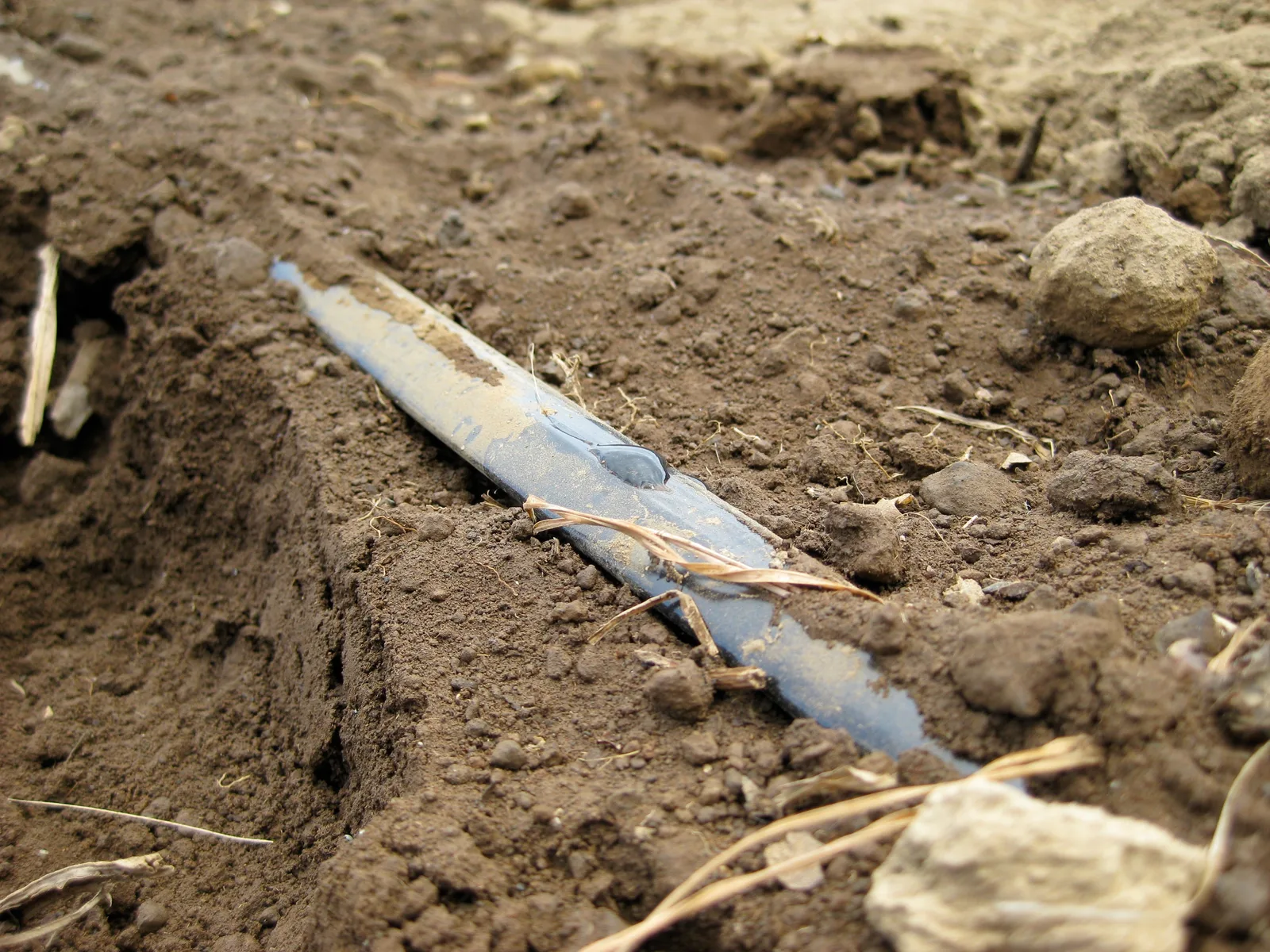

Begin with the area that needs to become wet
Draw the planting rather than the irrigation product. Mark dense rows, isolated plants, empty paths and any place where the line must cross without watering. A continuous planted strip and a collection of separated pots need different distribution patterns. Decide whether you want water released throughout a length or delivered at selected, repeatable points.
Colorado State Extension distinguishes soaker hoses, drip lines and individual emitters for vegetable gardens. These are related approaches to ground-level watering, not interchangeable names for the same hardware. In each case the soil's wetting pattern is the meaningful result. A line that fits neatly along a bed edge may still leave roots on the other side inadequately supplied. CSU vegetable-garden irrigation.
Write the question you need answered: can this layout wet the active root area without sending substantial water to unplanted space? That question is more useful than choosing a winner for every possible garden.
What a soaker hose offers
A soaker hose is a distribution device, not an ordinary transfer hose with a nozzle attached. Its porous length releases water near the ground. It can be a practical option for a planted strip where routing a flexible length is convenient and the owner is willing to inspect how the whole run wets the soil.
Check the exact product's length, fittings, end closure and supply instructions. Water Right's 700 Series is sold in finished and unfinished configurations, for example. A roll without the expected fittings is not equivalent to a ready-to-connect hose. Its specifications should not be generalized to every porous hose made from other materials. Water Right soaker-hose configurations.
Do not judge uniformity from the first few feet. Observe the beginning, middle and far end during a supervised run, then inspect the corresponding soil. If sections behave differently, investigate the layout and operating conditions instead of simply leaving the entire hose on longer.
What inline drip tubing makes explicit
Inline drip tubing has watering devices built into the tube at stated intervals. Product documentation can identify emitter spacing, nominal discharge and an operating range. Those specifications make it possible to plan repeated rows and estimate nominal zone demand. They do not eliminate the need to check actual delivery or establish that the spacing is right for your soil.
Rain Bird's ET25-50S2 illustrates this category with a 50-foot quarter-inch coil, 0.8 GPH emitters and 12-inch spacing. The manufacturer's stated operating range is 8.5–60 psi. That model is different from blank quarter-inch tubing and from larger dripline families. Do not transfer its dimensions or operating limits to another product with a similar photograph. Rain Bird inline emitter-tubing specifications.
Consider where the built-in spacing is helpful and where it becomes awkward. A long empty crossing may be better served by blank supply tubing. If isolated plants have very different requirements, a branch layout with separately selected emitters may be easier to adapt.
Compare the complete upstream assembly
Neither option should be selected in isolation from the supply. Check the water source, timer, backflow arrangements, filter and regulator against the chosen product's instructions. A device described as low pressure is not automatically suitable for a rain barrel, and a high-rated supply tube does not establish a safe setting for the watering line.
Record the actual connection sizes and thread types. A hose-end connection and a tubing barb solve different problems. Avoid relying on nominal labels alone, especially when combining a hose product with drip-system components. Ask the supplier for the exact adapter and regulator arrangement if compatibility is unclear.
UGA's drip planning guidance emphasizes available water output and the size of the garden. Apply that planning habit before expanding either distribution method. Adding more length or another bed changes the system, even if the extra piece connects successfully. UGA home-garden drip planning.
Prove spacing with a small, representative section
Choose a section that represents the intended soil, mulch and planting pattern. Install the line according to its instructions and run it while present. After water has had time to move through the soil, inspect below the surface and between lines. Record the result before deciding whether to duplicate that layout across several beds.
Look for both dry gaps and unnecessarily wet areas. A longer run may deepen the wet zone below a line without extending it sideways enough to reach all roots. Conversely, lines placed too close together may overlap more than needed. Treat the first layout as something to observe and refine, not a universal spacing rule copied from an unrelated garden.
Keep crop stage in mind when evaluating the result. A seed row, a newly transplanted plant and an established root system occupy different areas. The irrigation pattern may need adjustment as the planting changes, regardless of whether water comes from porous hose or metered outlets.
Evaluate repair and seasonal handling
Before buying a long run, find out how the maker expects it to be cleaned, flushed, repaired and stored. Identify compatible couplings, end closures and replacement sections. A product whose servicing instructions you understand is easier to keep useful than one that relies entirely on broad maintenance-free language.
Plan access around the bed. Lines hidden beneath heavy permanent structures are difficult to inspect. Keep service points identifiable and leave enough room to disconnect them without pulling against plants. During cultivation, know where the watering line lies before using a hoe or inserting a support.
Consider how often the layout changes. Annual rows may move from season to season, while a perennial border may retain a stable pattern. A useful choice should accommodate that routine without excessive cutting, improvised adapters or disposal. Store components according to the manufacturer's directions, including any draining and freeze precautions.
Price the same completed section on both sides
For a fair comparison, sketch one representative bed and list everything needed to water it. On the soaker side, include the hose length, inlet connection, any specified pressure control and the means of closing or connecting the end. On the inline side, include emitter tubing, supply tubing where needed, fittings, line closures, filter and regulation. Reuse existing compatible parts in both lists rather than charging them to only one option.
Then add a maintenance question beside each list: what would you replace if this section were damaged, and how would you open it for flushing or draining? This prevents the coil price from becoming the whole decision. A less expensive package can still be the right choice, but only after both lists describe a working section with comparable coverage. Keep spare parts to those that fit the chosen system; buying an assortment before confirming tubing dimensions can leave you with many connectors and no useful repair.
Make the decision from your own priorities
For a modest planted strip, a finished soaker hose may offer a straightforward layout if its operating instructions fit the source and the observed wetting is satisfactory. For repeated rows where known outlet spacing and nominal flow help planning, inline drip may be the clearer option. For widely separated plants, compare individual emitters rather than forcing either continuous arrangement to fit.
Include the practical costs you will actually encounter: appropriate upstream components, replacement fittings, time spent moving the line, and access for inspection. Do not compare only the purchase price of two rolls of different lengths. A cheaper roll requiring unsupported adaptations is not an equivalent system.
Your final decision should state the conditions: this method fits this planting pattern, this supply and this maintenance routine. Neither method earns a blanket promise of uniformity, water savings or better plant growth from its name alone. Observe the soil, document the layout that works, and reassess when the garden changes.
Sources & further reading
We favor university extension guidance and original product documentation. Linked sources support the specific facts cited; they do not endorse Garden Gear Atlas.
- CSU Extension: Irrigating the Vegetable Garden
- Water Right 700 Series soaker hose
- Rain Bird ET25-50S2
- UGA Extension: Drip Irrigation in the Home Vegetable Garden