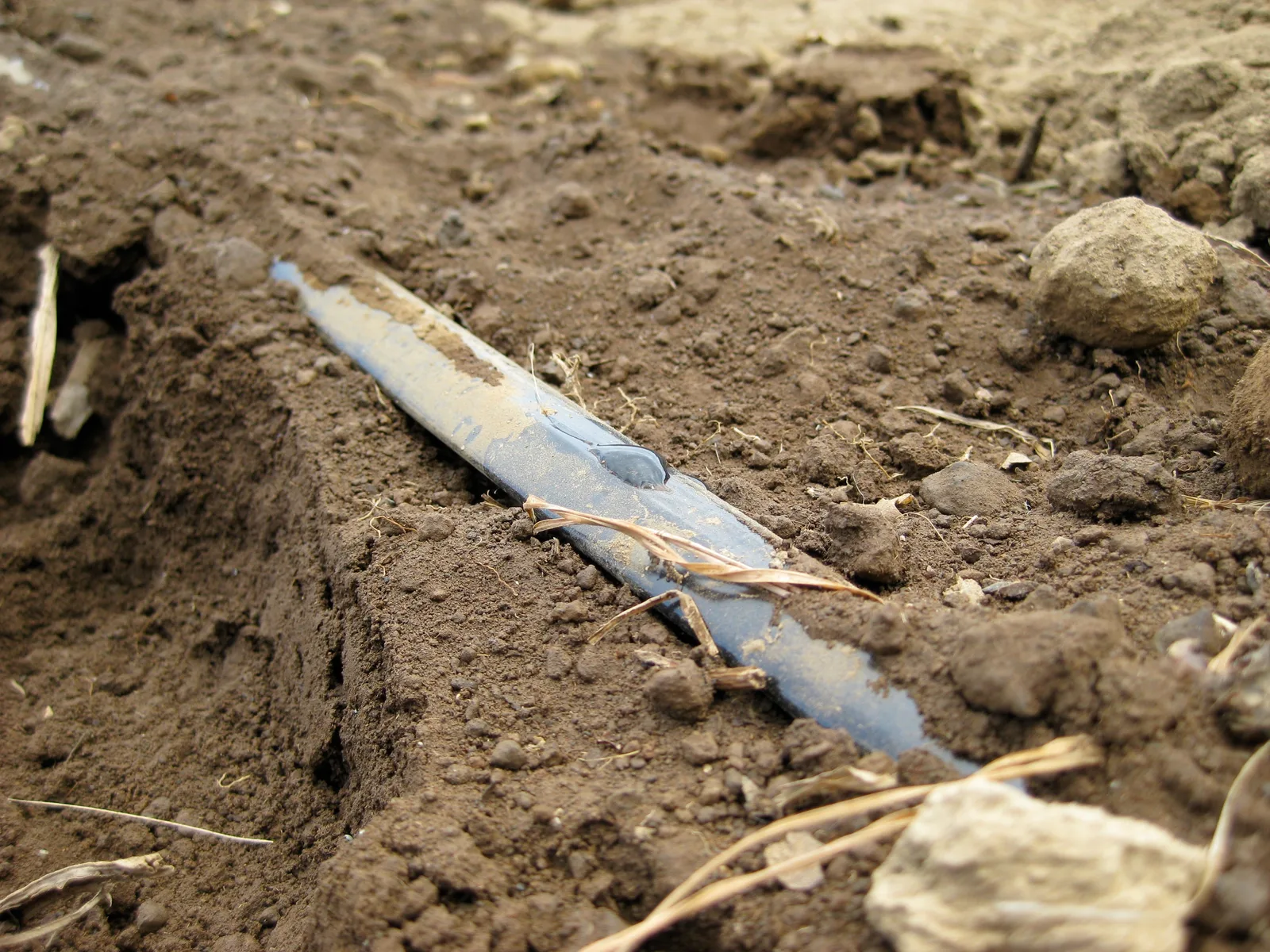

First, separate the two kinds of spacing
Emitter spacing is the distance between outlets along a drip line. Lateral spacing is the distance between neighboring lines. They answer different questions. A product with outlets every 12 inches does not tell you whether one, two, or three lines belong across your bed. It also does not tell you the operating pressure or the water delivered by each outlet.
Draw the bed and planting positions before comparing rolls of tubing. Add the water source, route to the bed, and any elevation changes you already know about. Mark the two spacing dimensions separately. That sketch turns a vague shopping question into a useful conversation with a supplier: which layout will wet the intended root area under these site conditions? Keep the answer provisional until you check it in use.
Soil changes the shape of the wetted area
Utah State University's commercial vegetable and fruit irrigation guidance says sandy and cracking soils require closer spacing than loam or clay-loam because of their different water-movement patterns. The home-garden lesson is not to borrow a neighbor's spacing without considering soil. Two beds can have similar dimensions yet need different layouts if their growing material behaves differently.
USU's tree-irrigation guidance also links emitter number to the area you intend to wet and the area wetted by each emitter. That relationship is useful, but published ranges are not a substitute for a site check. A surface damp spot does not show the complete underground wetting pattern. Investigate moisture beneath the surface carefully, avoiding damage to established roots, and ask local extension or an irrigation supplier how to evaluate your particular soil.
Match the outlet pattern to the planting job
For separate containers or widely separated plants, individually placed point-source emitters let you target specific locations. For repeated rows or a closely planted bed, inline tubing provides a regular pattern. USU's vegetable-water guidance describes both arrangements and notes that inline systems can form a grid. Choose the arrangement that matches the area you need to wet, not simply the kit with the largest printed plant count.
A row of new transplants and a densely sown seedbed are different targets. Ask whether the proposed layout will provide the moisture distribution needed at the current growth stage, and how you will adjust as plants develop. For a tree, do not treat one outlet beside the trunk as an automatically complete design. The area of concern is the rooting area you need to irrigate, not the easiest place to attach a tube.
Read flow units before calculating anything
A flow label may describe gallons per hour per emitter, liters per hour per emitter, or gallons per hour per 100 feet of line. These cannot be entered interchangeably. For example, 0.5 gallon per hour per emitter is not the same as 0.5 gallon per hour for a whole roll. Copy the exact unit into your notes beside the manufacturer's operating conditions.
Here is a count example, not a recommended layout. Four 10-foot runs with outlets spaced 1 foot apart and the first outlet 6 inches from each run's start contain ten outlets per run. That is forty emitters. At a rated 0.5 gallon per hour each, their total is 20 gallons per hour. If your cut tubing starts at a different point between emitters, count the actual outlets rather than assuming the example still applies.
Use a delivery estimate without turning it into a prescription
If those forty emitters really deliver 20 gallons per hour together, they theoretically deliver 10 gallons in 30 minutes. This is volume divided by flow, not a finding that your garden needs 10 gallons. To express a chosen quantity as equivalent depth, 1 inch over 1 square foot is approximately 0.6234 US gallon. Half an inch over 32 square feet is therefore about 9.97 gallons.
The equivalent-depth calculation spreads a volume over a stated area mathematically. Drip does not necessarily wet that area uniformly, and actual crop demand depends on conditions. USU's backyard guide emphasizes climate, soil water-holding capacity, season, and plant size as factors in water need. Use the calculator to understand delivery, then use crop guidance and observed soil moisture to decide when and how much to irrigate.
Check the water source and component limits
A bucket test can reveal the open-flow rate at your tap. Fill a known volume, time it, and divide volume by seconds before converting to an hourly rate. Five US gallons in 60 seconds corresponds to 300 gallons per hour. As USU explains, supply conditions can vary. An open-tap measurement is not proof of flow at the operating pressure required by the finished irrigation system.
Confirm the chosen tubing's maximum run length, rated pressure range, fitting dimensions, filtration needs, and regulator requirements with its documentation. Include suitable backflow protection under local requirements. A larger roll is not automatically better if the resulting run exceeds equipment limits. If the system needs zones, design those zones around actual limitations and planting needs; dividing total emitter flow by tap flow is only a preliminary arithmetic check.
Test a representative section before expanding
Build a manageable trial section using the intended components and operating conditions. Check outlets near the beginning and end, inspect connections for leaks, and examine how moisture distributes in the intended planting area. Record run length, spacing, flow rating, duration, and what you observed. This gives you a repeatable starting point if you adjust one part of the layout.
If plants remain dry between outlets, do not assume the only answer is a much longer runtime; first assess spacing and where water is going. If water accumulates or escapes the intended area, reassess application and site conditions. Keep the successful drawing and parts list for repairs. The drip planner can estimate tubing, emitter count, and delivery time, while the garden itself confirms whether the arrangement is doing the intended job.
Sources & further reading
We favor university extension guidance and original product documentation. Linked sources support the specific facts cited; they do not endorse Garden Gear Atlas.
- Utah State University Extension — Drip Irrigation for Commercial Vegetable and Fruit Production
- Utah State University Extension — Drip Irrigation for Trees
- Utah State University Extension — Water Recommendations for Vegetables
- Utah State University Extension — The Do-It-Yourself Guide to Backyard Drip Irrigation