Identify the orchid before choosing the bag
'Orchid mix' covers a broad group of plants with different root habits. This guide focuses on commonly grown Phalaenopsis, or moth orchids, rather than pretending that every orchid should receive the same recipe. Confirm the plant's identity from its label or a reliable identification resource. A potting instruction for a terrestrial orchid may not suit an epiphytic moth orchid, and a photograph of a flower is not always enough to establish the species or hybrid group.
Think of the medium as a structure that supports roots while managing air and moisture. It is not simply food to pack around a plant. The American Orchid Society discusses medium-grade bark for mature Phalaenopsis and repotting as the material deteriorates. That places the focus on root conditions and medium breakdown rather than a fashionable ingredient list. American Orchid Society: Phalaenopsis culture.
Inspect what is already around the roots
Look through a clear pot where possible, but do not assume that the visible outer pieces describe the entire interior. A plant may have coarse bark outside a denser propagation plug or a tightly packed moss center. Those areas can dry at different rates. During a justified repot, note the arrangement before changing it. That observation may explain why the outside seemed dry while central roots remained wet.
An aerial root is not automatically a problem requiring burial, and a silvery root should not be cut solely because it is not green at that moment. Assess firmness, damage, and the plant's growth pattern. Avoid forcing every projecting root inside a larger pot to make the plant look contained. If the root system is deteriorating, identify and address the cause; buying a more expensive mix does not by itself reverse damage already present.
Understand the practical bark-versus-moss tradeoff
Coarse bark creates larger spaces between pieces and can be comparatively easy to inspect visually, but a fresh bark mix may require careful initial wetting. Sphagnum can retain substantial moisture, and its behavior changes with packing, pot ventilation, and the amount used. Neither ingredient has one universal watering interval. The relevant question is whether the assembled pot lets you maintain the moisture pattern appropriate for your orchid.
Use your actual routine as a filter. If you tend to water too often in a cool room, a tightly packed moisture-retentive center deserves special caution. If a very open pot dries rapidly in warm moving air and you cannot check it often, maximum openness may not be convenient either. Do not interpret 'fast draining' as 'impossible to overwater.' Water movement out of the pot and the moisture retained around roots are related but different observations.
Compare particle size and additives, not marketing intensity
Read the product ingredients and intended orchid group. Better-Gro's Special Orchid Mix lists western fir bark, hardwood charcoal, and sponge rock, while its Phalaenopsis blend is a separate formulation. These are distinct mixtures, so choose deliberately rather than assuming similarly branded bags are interchangeable. The manufacturer's ingredient listing helps identify the product, but does not establish that it is the best mix for every home. Better-Gro: orchid potting media.
Small fragments fill spaces differently from large chunks, and decomposed bark behaves differently from fresh bark. For a small root system in a small pot, very large pieces can make anchoring awkward; for a larger established orchid, excessively fine material may not provide the intended structure. Buy a manageable quantity that you can keep clean and dry in storage. Avoid adding household charcoal, construction materials, or random garden soil as substitutes for labeled horticultural ingredients.
Choose the pot by roots and access
A clear slotted pot can make some observations easier and allows water to leave through multiple openings, but it remains a tool rather than a guarantee of healthy roots. Check its inside dimensions and fit within any decorative cover. Slots pressed tightly against another vessel may not provide the airflow you imagined. The root ball should fit appropriately without requiring a large unused volume simply to accommodate an attractive outer pot.
Consider how you will remove the pot, water it, and let it drain. A tall flower spike can make an otherwise small plant awkward to carry, so prepare a stable route and support before lifting. Do not suspend a heavy decorative pot from the flower stake or use foliage as a handle. If roots have grown through slots, avoid tearing them free during a routine inspection. Plan a gentler removal at repotting time when necessary.
Repot for a reason, with the next watering in mind
Repotting is useful when the medium has broken down, the container no longer suits the healthy root system, or root problems require attention. Healthy flowering plants and plants with urgent root deterioration may need different timing decisions. Chicago Botanic Garden's orchid-care guidance emphasizes examining roots and removing dead or diseased material with sanitized tools during repotting. Use that assessment, not a blanket rule that every purchased orchid must immediately be stripped. Chicago Botanic Garden: caring for orchids.
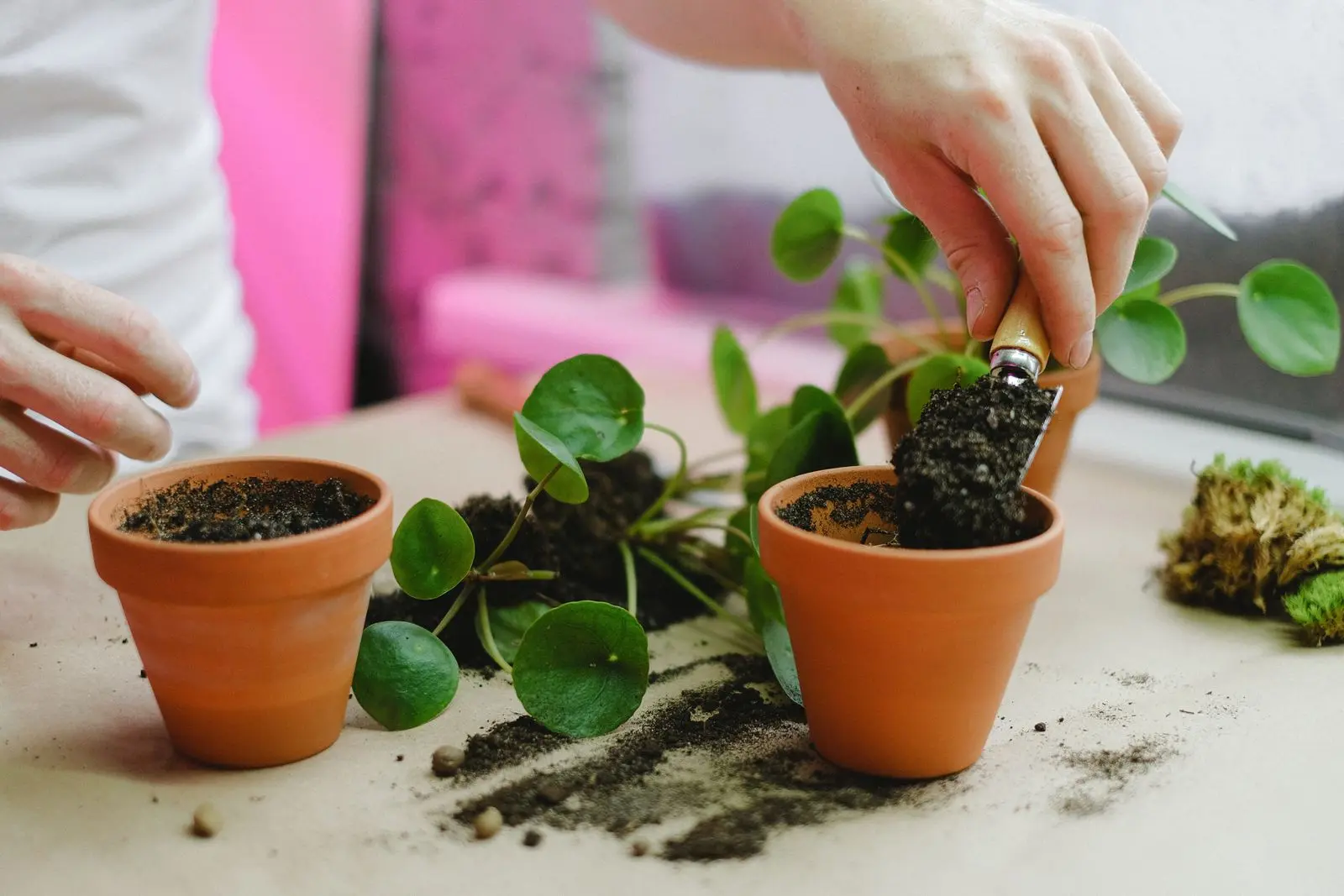
Prepare the new medium according to its directions, use a clean pot, and support the plant at the appropriate level without burying the crown. Remove deteriorated material carefully rather than aggressively scraping healthy roots. Follow orchid-specific aftercare for any root trimming. Photograph the finished arrangement and label the date and medium. If you changed from moss to bark, recognize that the old watering routine is no longer a dependable guide.
Learn the drying pattern from several observations
After watering and drainage, note the pot's weight if safely liftable, the appearance of accessible medium, and what you can see through the sides. At subsequent checks, compare those observations rather than relying on a single exposed bark chip. The center may remain damp after the surface has dried. Clear-pot condensation can contribute information but should not be treated as a precise moisture measurement or the only cue to irrigate.
Water with a method suited to the plant and medium, keeping trapped water out of vulnerable areas and allowing excess to escape. Do not share soaking water between healthy plants and a plant with suspected disease. If water bypasses dry material, correct the wetting process rather than simply doubling the next interval. If the pot stays wet unexpectedly long, inspect the combination of root condition, packing, cover-pot clearance, temperature, and light before adding more water.
Keep the recipe adjustable without chasing novelty
A well-performing orchid does not need a new mixture every time a grower publishes a different recipe. Keep records of what works in your setting: exact medium, approximate particle size, pot type, position, and the range of drying behavior you observe. Those details make the next repot reproducible. If a replacement bag has visibly different texture, treat it as a change worth monitoring rather than assuming the label ensures identical behavior.
The useful final choice is a pot-and-medium combination you can water consistently while preserving appropriate root conditions. Bark may be convenient, moss may be useful, and a blend may suit a particular home; the evidence is how the living roots and subsequent growth respond. Avoid promises of guaranteed reblooming or root-rot prevention. Medium selection solves the root-zone structure problem, while light, temperature, nutrition, and the plant's own condition remain separate parts of orchid care.
Sources & further reading
We favor university extension guidance and original product documentation. Linked sources support the specific facts cited; they do not endorse Garden Gear Atlas.
- American Orchid Society: Phalaenopsis culture sheet
- Better-Gro: orchid potting-media ingredients
- Chicago Botanic Garden: orchid care